I've been thinking a lot about mass psychosis lately, not as an abstract theory, but as something I watched unfold in real time. I watched it from inside the early social media trenches.
When I woke up in late 2011, everything changed for me almost overnight. Before that, I hated the internet. I was not someone who sat online all day digging through information. Back then, I didn't even have a Facebook page, but my kids forced me into creating one. Then one day I saw someone post something about 9/11, and I walked through the information like I had entered one doorway and came out another person on the other side.
Whether someone agrees with my conclusions or not is not the point of this story. The point is what happened to me. Something opened up inside me. People around me could not believe how much information I absorbed in such a short amount of time. It felt less like I had found a hobby and more like my spirit had taken over and given me meaningful work to do.
Soon after, I became an admin on the huge Facebook page Exposing The Truth. I became one of their top posters. But the person running the page had different ideas about where to take the media and we had conflict. At least that is how it felt to me. Eventually I was banned, and I was crushed.
My son Jordan saw how depressed I was and told me to start my own Facebook page. But, with my spirits so down, I couldn't think of a name and had no creative energy going. Then, he came up with A Sheep No More, meaning I was no longer asleep (a sheep) anymore. That name came from him, and it still means something to me.
Back then, social media was different. This was before everyone was an expert, before every person with a phone became a broadcaster and influencer, before one-minute clips trained people to mistake stimulation for knowledge.
Source: 2013 The Hegelian Dialectic by A Sheep No More
Jordan used to sit with me and watch what happened when I posted. I would put up a meme, and within minutes there would be thousands of likes and shares. It was instant. You could feel the machine light up. I bought Photoshop, started editing images, tweaking messages, making my own visuals, and that became part of how A Sheep No More grew so quickly.
I would go onto other large pages and post my memes in the comments. The likes and follows would come. It was time consuming, but the competition was not what it is today. The alternative media world had not yet become the crowded, monetized, dopamine driven circus it later became.
In a very real way, I helped build the early meme culture in the alternative media space. And then I watched what it did to people.
At first, memes felt powerful. They could wake someone up in one image. They punched through people's denial systems, and they could say what a long article might take two thousand words to explain.
But over time, I started seeing the downside. People began reading less. They were sharing more. Verification mattered less than the emotional impact of a post. If something looked true, felt true, or confirmed what someone already believed, they would pass it along without any investigation. The meme became the message. Then the message became a weapon.
I decided to test what I was seeing. In July of 2015, for one month, I deliberately posted more sensational conspiracy content. Illuminati this. Puppets of the Illuminati that. Symbolism, fear, New World Order information about control, all the things that triggered people’s curiosity and outrage.
And guess what happened?
The website views went up and so did the ad money I was making off Adsense and other ad platforms. And I was so disappointed about what it proved.
It proved that the audience was being trained to respond more strongly to fear, symbols, and sensationalism than to deeper research. It proved that the machine rewarded escalation. It proved that if I wanted more traffic and more money, I could get it by feeding the very thing I believed was harming people.
And after that month-long experiment, I couldn't do it anymore and made a decision to forfeit the money that could be made and go back to living my moral truth.
That was one of the first times I truly understood that the alternative media world had its own sickness. It was not just mainstream media lying to people. It was not just politicians, corporations, or governments manipulating perception. The so-called truth movement had its own dopamine economy, its own ego traps, its own grifters, and its own mass psychosis.
I watched people I knew take political sides because it made them more money. Some even admitted it to me and didn't understand why I would not participate in it. I watched pages become brand experts. I watched truth become weaponized, and I watched awakening become performance driven.
That was deeply disturbing to me because I had come into this from a soul calling. I believed truth had to be handled with integrity and care. If I did not know something, I wanted to say I did not know. If something was only my theory, I wanted to say it was my theory. I respected real journalists and independent researchers who did the work, and I often showcased their articles with permission because I wanted to promote serious work.
But integrity is not always rewarded financially. And this is where the conversation about mass psychosis becomes personal for me.
Mass psychosis is not only something that happens when governments use fear, confusion, contradiction, and repetition to pull entire populations into a shared perception. That is all real. But there is another layer. The platforms themselves became psychological conditioning machines. They trained people to react instantly, to skim instead of study, to share before verifying, and to confuse emotional arousal with truth.
The mainstream media did it. The alternative media did it, and social media perfected it.
Then came the influencer era, where everyone had a brand, everyone had a take, everyone had a theory, everyone had a product, everyone had an audience, and too many people with no real depth, discernment or wisdom were suddenly treated like authorities.
By the time the TikTok-style short clips took over the culture, it felt like the final insult. Humanity’s attention span had been chopped into pieces, and people were now being fed reality in one-minute bursts of outrage, trauma, comedy, propaganda, and ego performance. This was an unknown insult to people's nervous systems.
It made me nauseated because I remember when things felt different. It wasn't easier back then, but it was different from what it's become today.
Back in 2012 and 2013, people still read and digested the content. They dug. They debated. There was still a sense that information mattered. By 2018 and 2019, I could feel the shift hardening. It seemed like everyone was becoming an expert, everyone was chasing social media reach, and everyone was posting to feed the algorithm, the audience, and themselves.
And now AI has made it even worse.
AI comments. AI videos. AI articles. AI voices. AI images. People trolling other sites to get traffic. People pretending to research when they are really just recycling content. The information field feels polluted beyond anything I could have imagined when I first started. And it's producing another problem of information overload for the central nervous system.
That is why a random comment I noticed under one of my blog articles bothered me so much. Because I know the pattern. Someone programs AI to see a keyword like “mass psychosis” and drops a whole manifesto that barely responds to the article. It is not conversation. It is a payload for them. I recognize the tactic because that is what years inside this world taught me.
The real issue is not whether people are awake or asleep. That language is way too simple now. Some people “wake up” only to become addicted to exposing everything outside themselves while never facing what is happening inside themselves. They leave one trance and enter into another.
I know because I went through stages too.
There is grief when you first wake up. You're angry, shocked and then the obsession hits and that need to tell everyone about it takes over. A need to prove it. A need to shake people. But eventually, if the awakening is real, it has to turn inward.
Around 2015 or 2016, something became clear to me. The only way to combat what was happening in the outside world was to work on myself. To calm my own nervous system. To stop letting fear and anxiety of the future own my body. Yoga became part of that for me and so did studying the Kybalion and the Hermetic principles. The more I understood the inner laws, the less interested I became in living inside constant external chaos.
That does not mean I stopped caring about the world. It meant I understood that an unregulated person can become another carrier of the very madness they claim to oppose.
That is the part so many people are missing.
You cannot expose manipulation while being manipulated by your own fears and anxiety. You cannot fight mass psychosis while addicted to the emotional rewards of the crowd. You cannot claim to be free while needing likes, shares, followers, money, or outrage to tell you who you are.
I was an influencer before “influencer” became a career. But I did not want to influence people into worshiping me. That is why I stayed with the A Sheep No More avatar back then, and decided not to disclose who was behind it. I wanted to influence consciousness and wanted people to think, question, read, feel, and grow.
Today, my work is barely seen compared to what it once was. And honestly, I wouldn't want the responsibility of that kind of reach right now. I know what it costs, I know what it can do, and I know how easy it is for the machine to turn even sincere people into performers and payload operators.
But I also know what I saw. I saw the meme become a doorway, and then I saw it become a drug. I saw alternative media rise as a response to deception, and then I saw parts of it become another deception.
I saw people wake up, and then I saw many of them get trapped in the dopamine maze.
So when I talk about mass psychosis, I am not speaking as someone who merely watched a video or read a theory. I am speaking as someone who was there when the social media mind-war was still young, when memes could move thousands of people in minutes, when the hunger for truth began being redirected into the hunger for stimulation, dopamine, money, and fortune.
That is why I still believe discernment, integrity, and wisdom matter. And that is why I believe real awakening is not just seeing through the world’s lies, but having the courage to turn inward and do the work on the self. Some call that the dark night of the soul. I call it the part of awakening most people try to avoid.
He doesn’t come from the usual tech world path. No coding background, no startup grind, no garage story that turns into billions. Alex Karp shows up differently, trained in philosophy, spending years in Frankfurt studying things like human behavior and aggression, then suddenly leading Palantir Technologies, a company deeply tied to surveillance, data, and military systems. That sharp shift, from academic thinker to the head of a powerful data empire, is where things start to feel off, like pieces that don’t quite line up.
The official version is tidy. Born to a Jewish pediatrician and an African American artist, raised in a politically active household, academically inclined, eventually crossing paths with Peter Thiel at Stanford. A philosopher meets a financier, and together they build a post-9/11 data empire. Clean. Linear. Almost too clean.
But when you read it slowly, it feels less like a biography and more like a recruitment file. Philosophy, specifically social theory, isn’t just abstract thinking. It’s the study of systems, power, behavior, how people respond to control and narrative. Frankfurt isn’t just a university town; it’s historically tied to frameworks that dissect and reconstruct society itself. If you were designing someone to sit at the intersection of data, control, and human behavior, you wouldn’t pick a coder first. You’d pick someone who understands how humans think, break, comply.
Then there’s the jump. No engineering background. No track record building software. Yet he becomes CEO of a company backed early by intelligence-linked funding streams. Not as the builder, but as the face. The interpreter. The translator between machine logic and human acceptance.
That’s where the “programmed asset” theory starts whispering.
Some start to frame it through older models of conditioning like ideas tied to programs like MKUltra where individuals aren’t just trained, but shaped over time to carry conflicting roles without breaking. A long runway where a certain personality is shaped to tolerate contradictions that would fracture most people. Publicly he identifies with left-leaning, almost anti-establishment roots. Professionally he leads a company embedded with military, intelligence, and surveillance infrastructure. Two identities that shouldn’t sit comfortably in the same body, yet in him, they do. Seamlessly.
Watch him speak and the unease sharpens. The pacing. The restless energy. Sentences that spiral into high philosophy when the question is simple. It doesn’t feel like deflection in the usual corporate sense. It feels like translation lag... like he’s processing something at a different layer and pushing it back out in fragments that sound profound but never quite land in plain language.
Then comes the physical discipline. Extreme. Almost ritualistic. Hours of skiing. Tai chi. Controlled routines that strip away distraction. It reads less like lifestyle and more like maintenance. Keep the system tuned. Keep the mind sharp. Keep the noise out.
And then the company itself... this is where the theory locks in.
Palantir doesn’t just analyze data. It builds what it calls “ontology” which is a structured map of reality. A digital twin of systems, organizations, eventually people. Not just what happened, but what will happen. Prediction, patterning, behavioral modeling. The human reduced to variables, inputs, outputs.
If someone believed in turning humanity into “nodes,” this is the architecture you’d build.
So the thought experiment flips. He doesn’t need to be fake. He doesn’t need to be AI. He just needs to be the first successful bridge, someone who can live inside that system without resisting it. Someone who sees humans the way the software does: as patterns to map, optimize, and, if necessary, override.
The sparse personal life feeds it further. No conventional family structure. Relationships compartmentalized. Minimal digital footprint outside controlled appearances. He exists publicly almost only when aligned with the mission. More like a function, not a life.
Even the quirks feel curated. Just enough eccentricity to signal “human,” but never enough to derail the role. The kind of controlled unpredictability that disarms scrutiny instead of inviting it.
So the article doesn’t land on proof. It lands on pattern.
A philosopher trained in systems of power. A decade in intellectual environments focused on shaping human behavior. A sudden rise into a company that operationalizes that knowledge at scale. A personality that absorbs contradiction without fracture. A public presence that feels both real and slightly off, like something running at a different frequency.
It still doesn’t read like a normal life story, and once you layer in the older frameworks, programming, behavioral conditioning, the kind of research that came out of things like MKUltra, the same traits start to look less random and more.... patterned.
MKUltra, at its core, wasn’t just about crude mind control. It was about behavioral shaping, identity fragmentation, conditioning responses under stress, and, most relevant here, creating individuals who could operate under contradiction without breaking. People who could hold two opposing realities and function cleanly inside both. That idea alone casts a different light on someone like Alex Karp, whose entire public persona is built on contradiction: anti-establishment roots paired with deep-state alignment, philosophical abstraction paired with military application.
His physical behavior starts to read differently through that lens. The inability to sit still, the constant movement, the high-strung energy that went viral... those aren’t just quirks anymore. In a “programmed asset” framework, they look like leakage. Residual tension. A system always running hot. Something that never fully powers down. The extreme routines, hours of skiing, rigid physical discipline, repetitive practices like tai chi, feel less like hobbies and more like regulation mechanisms, ways to stabilize whatever internal wiring is constantly firing.
Then there’s the security detail. On paper, it’s standard for a billionaire tied to government contracts. But the theory flips it: containment, not protection. Handlers, not guards. People who aren’t just there to keep threats out, but to keep the asset within bounds. Always close. Always present. Not casual.
The information around him is equally tight. For someone running a company that maps the world’s data, his own footprint is oddly curated. Family details exist, but only in broad strokes. Personal life is compartmentalized, abstracted, almost deliberately flattened. No organic mess, no uncontrolled narrative drift. Just enough humanity to pass, never enough to fully see.
And then the autism thread enters, and the whole structure widens.
Over the past two decades, autism diagnoses have surged dramatically, particularly in boys. Official explanations talk about awareness, better diagnostics, expanded definitions. But in the thought experiment, another possibility gets entertained: what if the traits themselves are being selected for? Not created in a lab in some dramatic sense, but cultivated, amplified, incentivized.
Because when you look at the cognitive profile often associated with autism, pattern recognition, systemizing, reduced emotional noise, hyper-focus and it aligns almost perfectly with the needs of a data-driven world. With the needs of something like Palantir Technologies. With the needs of building and maintaining digital systems that model reality itself.
Now fold in Karp’s public embrace of “neurodivergence.” The reframing of what used to be seen as limitation into strategic advantage. The creation of pipelines, like fellowships, that actively seek out those minds. In isolation, it looks progressive. In the larger pattern, it starts to resemble targeting. Identification. Recruitment of a specific cognitive type that fits seamlessly into a machine-logic environment.
In that frame, Karp isn’t just leading a company. He’s signaling to a class of minds: this is your place, your value, your future. Come here, where the system matches how you already think.
And if the MKUltra-style lens is applied again, it raises a darker extension. Not that all neurodivergence is engineered, but that once a pattern is recognized, systems begin to optimize for it. Reward it. Channel it. Build structures around it until it becomes the dominant operating mode in certain sectors.
That’s where the “node” idea stops sounding metaphorical.
A workforce that thinks in systems, operates with minimal emotional interference, and interfaces naturally with data architectures isn’t just efficient, it’s compatible. Almost interchangeable with the logic of the machine itself.
So when you circle back to Alex Karp, the pieces sit differently.
The contradictions he holds without visible strain of a philosopher turned defense-tech operator, anti-establishment roots fused with institutional power.
The strangely limited and curated background that's just enough detail to exist, never enough to fully see, with long stretches of his life flattened into simple explanations.
The restless, almost overclocked physical presence with the inability to sit still, the constant motion, like a system that never fully powers down.
The rigid self-regulation with extreme routines, controlled habits, a life stripped of excess, tuned more like maintenance than comfort.
The constant proximity of protection. Security that feels less like distance and more like presence, always there, never casual.
The compartmentalized personal life, no traditional structure, no organic mess, relationships abstracted and kept at the edges.
The controlled narrative of minimal digital footprint outside of what serves the role, no drift, no unpredictability, no unscripted version leaking through.
And over all of it, the philosophical framing of a world where humans are mapped, predicted, and optimized where behavior becomes data, and data becomes control.
None of it proves anything. But together, it sketches a silhouette that fits unusually well with an old idea updated for a new era:
Not just a man running the system.
A man shaped to live inside it and quietly pull others toward it. A programmed asset.
Investigators believe the CIA used Saudi Arabia as a go-between to recruit the two hijackers' in order to circumvent laws forbidding the Agency from conducting spy operations on U.S. soil.... declassified court filing has appeared to confirm what Infowars has long ago reported: the 9/11 attacks were perpetrated in part by U.S. government assets (and Israel).
A court filing from the Guantanamo Military Commission, the court considering the cases of defendants accused of carrying out the terrorist attacks in New York on September 11, 2001, reveal that the CIA was closely monitoring two of the hijackers, and may have even recruited them before they flew planes into the World Trade Center buildings.
The filing was originally published in July 2021 but was heavily redacted. Now a “unexpurgated” copy has been provided by independent researchers, according to RT’s Felix Livshitz.
The document details DEA veteran Don Canestraro’s investigation of potential Saudi government involvement in the 9/11 attacks, conducted at the request of the defendants’ lawyers.
Canesraro and numerous FBI agents in the investigation appear to conclude that the CIA obstructed official investigations ostensibly to conceal its infiltration of Al Qaeda.
Of the great many enduring mysteries of the 9/11 attacks still unresolved over two decades later, perhaps the biggest and gravest relate to the activities of Nawaf al-Hazmi and Khalid al-Mihdhar in the 18 months leading up to that fateful day. The pair traveled to the US on multi-entry visas in January 2000, despite having repeatedly been flagged by the CIA and NSA previously as likely Al Qaeda terrorists.
Mere days before their arrival, they attended an Al Qaeda summit in Kuala Lumpur, during which key details of the 9/11 attacks are likely to have been discussed and agreed. The meeting was secretly photographed and videotaped by Malaysian authorities at the direct request of the CIA’s Alec Station, a special unit set up to track Osama bin Laden, although oddly, no audio was captured.
Still, this background should’ve been sufficient to prevent Hazmi and Midhar from entering the US – or at least enough for the FBI to be informed of their presence in the country. As it was, they were admitted for a six-month period at Los Angeles International airport without incident, and Bureau representatives within Alec Station were blocked from sharing this information with their superiors by the CIA.
When a member of the CIA’s Alex Station suggested informing the FBI about the two hijackers obtaining visas to the U.S., he was shut down.
“We’ve got to tell the Bureau about this. These guys clearly are bad. One of them, at least, has a multiple-entry visa to the US. We’ve got to tell the FBI,” Mark Rossini, a member of Alec Station, recalled telling his colleagues. “[But the CIA] said to me, ‘No, it’s not the FBI’s case, not the FBI’s jurisdiction.’”
The FBI agents in the files claimed the CIA also concealed information from the bureau about the two hijackers’ main U.S. contact, Omar al-Bayoumi, who was under FBI investigation.
Additionally, they believe the CIA used Saudi Arabia as a go-between to recruit the two hijackers’ in order to circumvent laws forbidding the Agency from conducting spy operations on U.S. soil.
Though the lead investigator Canestraro doesn’t assert the reason behind the CIA’s decision to withhold information from the FBI that could have prevented the 9/11 attacks, the nature of the CIA’s clandestine Alec Station suggests nefarious motives.
“Canestraro does not make any conclusions as to why the CIA concealed vital information from the FBI prior to the attacks, which potentially could have prevented their execution, and why the Bureau subsequently played along with the Agency’s coverup. Although one answer is provided by the unusual nature of Alec Station’s setup,” Livshitz wrote.
“Namely, that far from infiltrating an Al Qaeda cell to avert terrorism, the Agency was seeking to influence and direct its activities in order to cause terrorism, outside standard recruitment channels. Having stumbled upon such a monstrous connivance, the FBI would’ve known well to leave the entire subject well alone.”
Update (1300ET): During a press conference, the NTSB referenced a video from Salem, Ohio, about 20 miles from East Palestine which shows sparks and flames emitting from beneath the train. The apparent structural issue with the train was captured on a security camera when it was travelling through Salem. According to Michael Graham, board member on the NTSB, two videos they had obtained were indicative of mechanical issues attributed to the rail car axles which likely led to the derailment.
The second video obtained from when the train was passing through Salem was recorded by a processing plant nearby a hotbox detector which scans the temperature of the axles as trains pass by. According to Graham, the wayside defect detector reading resulted in an alarm alerting the crew of a mechanical issue shortly before the derailment in East Palestine. Consequently, that alert forced the train to execute an emergency brake application which may have been the cause of the derailment. Presently, the NTSB is reviewing the trains data and audio recordings in order to examine the cause of the derailment and which hotbox detector indicated a mechanical error preceding the accident. The NTSB is expected to issue a preliminary report on its findings within 30 days.
* * *
Submitted by 'BlueApples',
While the US government is dispensing millions of dollars in resources to treat balloons as an existential crisis, a small town in Ohio finds itself engulfed in what actually looks like the apocalypse. Perhaps by design, all of the drama surrounding violations of US airspace by Chinese spy initiatives has done well to keep what is becoming one of the worst environmental disasters in recent memory from getting any headlines.
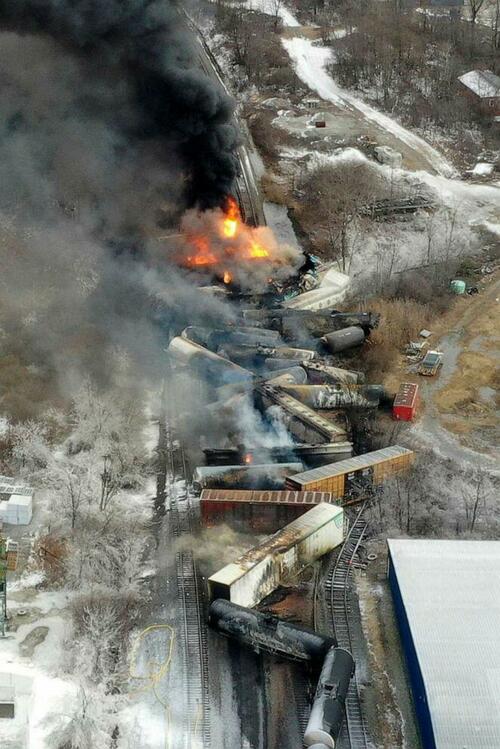
The chaos began early last week when a train of more than 100 cars derailed in East Palestine, Ohio near the state’s border with Pennsylvania with roughly 5,000 residents. The accident launched fifty of those hundred freight cars from the tracks. Twenty of the freight cars on the train were carrying hazardous materials, ten of which were derailed. While the accident had no fatalities, of those ten cars, five contained pressurized vinyl chloride, a highly flammable carcinogenic gas.
Scenes from East Palestine
In order to address the volatile scenario around the crash site, the Ohio Emergency Management Agency executed its plan of venting the toxic gas with a controlled burn in order to evade an uncontrolled explosion which presented the risk of catastrophic damage. “Within the last two hours, a drastic temperature change has taken place in a rail car, and there is now the potential of a catastrophic tanker failure which could cause an explosion with the potential of deadly shrapnel traveling up to a mile,” Gov. Mike DeWine warned in statement explaining the decision to take action to avert widespread devastation.
However, that operation sent large plumes of smoke containing vinyl chloride, phosgene, hydrogen chloride, and other gases into the air as the flames from the controlled burn raged on for days. Phosgene in particular is a highly toxic gas that can cause vomiting and respiratory issues. The toxicity of phosgene gas is so potent that it was previously used as a chemical weapon during the First World War.
NEW TOXINS IDENTIFIED—“We basically nuked a town with chemicals so we could get a railroad open,” said Sil Caggiano, a hazardous materials specialist. Rail company Norfolk Southern is paying just $25k to the town, or ~$5 per resident.🧵
The hazardous airborne chemicals prompted officials to issue mandatory evacuation and shelter-in-place orders within a one-mile radius of where the train derailed. Those orders forced nearly 2,000 residents of East Palestine out of their homes. Despite the public safety risk in proximity to the crash site, over 500 people within the parameters of the evacuation order refused to leave their homes. However, those orders were lifted on February 8th, allowing residents to return to the area adjacent to the disaster.
Following the controlled burn, local authorities received multiple concerning reports from residents outside of the mile-long radius of the evacuation area conveying that the emergency posed by the disaster was far from over. One local farmer reported the sudden deaths of many of the animals on the premises of his farm, Park Dairy. The farmer, Taylor Holzer, also works with the Ohio Department of Natural Resources as a registered foxkeeper. Following the disbursement of chemical agents into the air from the controlled burn, many of the foxes on Holzer’s farm experienced fatal effects from the air quality surrounding the area.
“Out of nowhere, he [a fox] just started coughing really hard, just shut down,” Holzer recalled to local media outlet WKBN 27 News. “This is not how a fox should act. He is very weak, limp. His eyes are very watery and weepy. Smoke and chemicals from the train, that’s the only thing that can cause it, because it doesn’t just happen out of nowhere,” he added.
“The chemicals that we’re being told are safe in the air, that’s definitely not safe for the animals…or people.”
Dead fish are being pulled from rivers outside East Palestine, Ohio.
The trucks doing the work are labeled EnviroScience, an Ohio-based company that provides "time-sensitive solutions to environmental challenges."
#6 The EPA sent a letter to the rail company, stating that ethylene glycol monobutyl ether, ethlyhexyl acrylate, & isobutylene were also in the rail cars.
“We basically nuked a town with chemicals so we could get a railroad open.”https://t.co/C69iWUpMvK
Holzer’s concerns were echoed by reports from other residents who described similar conditions near their own properties. One of those residents was Katlyn Schwarzwaelder, the operator of a local dog kennel in nearby Darlington, Pennsylvania. The catastrophe caused her to leave her home despite the fact that it lies more than 10 miles away from the site of the controlled burn. After fleeing to Boardman, Ohio, 15 miles away from the derailment, Schwarzwaelder stated she received multiple reports of dead chickens, fish, and other animals from friends and acquaintances. One affected resident told Schwarzwaelder that they let their 2-year old dog out to use the bathroom only for it never to return. When they embarked upon a search for their missing pet, they found it dead in their yard.
Testimony from Holzer, Schwarzwaelder, and others paints a drastically different picture than the official narrative tailored by officials who assured residents that the situation was under control. The poor air quality presents short and long term health risks to the public considering the carcinogenic effects of the chemicals. Carcinogens like vinyl chloride can cause cancer in organs including the liver, according to Kevin Crist, a professor of chemical and biomolecular engineering who also serves as the Director of Ohio University’s Air Quality Center.
Although officials in charge of the emergency response utilized techniques like dispersion modeling in order to calculate and mitigate the risk of airborne chemicals, the chemicals disbursed following the derailment pose other significant risks of contamination. Chemicals also spilled into the Ohio River toward West Virginia, prompting officials from the neighboring state to shut down water production in the area and turn to alternative sources for water supply. Soil contamination is another significant risk that leaves officials weary of broader implications affecting public health than those associated with the air pollution alone.
However, the magnitude of those risks hasn’t been apparently recognized by the leadership across various states affected by the disaster. According to Pennsylvania Governor Josh Shapiro, there were no concerns regarding the air and water quality in the area. Nevertheless, the governor reiterated that a shelter-in-place order remained in effect for Pennsylvanians within two miles of East Palestine. Officials from the Environmental Protection Agency took a similar tone, stating nothing unexpected was seen following the controlled burn. James Justice of the EPA summed up his agencies position by saying “So far, so good and we’re going to continue to monitor until the fire’s out,”.
While the immediate risks presented by a possible explosion following the train’s derailment may have been averted, the emergency response may become an instance of a cure being worse than the disease it seeks to remedy. The accidents also brings the state of safety regulations surrounding rail transport of hazardous freight into a new light. Over the last five years alone, eight train derailments have occurred in the Pittsburgh metro area, leading to calls for increased oversight over the industry.
Despite the inherent risk that comes with transporting chemicals like vinyl chloride, the US Department of Transportation approved a rule to expand the scope of what hazardous materials can be transported by rail. The rule made it permissible for liquefied natural gas to be shipped by train without additional safety regulations. This enables freight trains to transport 100 more tank cards with up to 30,000 gallons of the natural gas extracted from shale fields.
“The risks of catastrophic liquefied natural gas releases in accidents is too great not to have operational controls in place before large blocks of tank cars and unit trains proliferate,” the National Transportation Safety Board wrote in a comment if support of the proposed rule. In response to that comment, critics of the rule highlighted how a potential explosion of just twenty-two tank cards filled with liquefied natural gas holds the same amount of explosive energy as the atomic bomb dropped on Hiroshima in the waning days of the Second World War.
This chemical release in Ohio looks really bad, and the media is barely talking about it.
The ongoing crisis in East Palestine represents an environmental and humanitarian disaster that hasn’t been seen in the United States in recent memory. The scenes from East Palestine look as if they’re taken straight out of a horror film depicting nuclear winter.
I’m trying to gather information on this very serious situation in Ohio involving a train derailment with hazardous chemicals.
What I will say is this. Trust your eyes, ears and nose and get the hell out of there if your senses are telling you too.
“Who controls the food supply controls the people; who controls the energy can control whole continents; who controls money can control the world.”
This famous quote by Henry Kissinger is ringing more and more true by the week. The globalists already control the majority of the money, are moving ever so swiftly to convert the energy system over into systems they are all invested in, and have been taking drastic measures to control the food industry while running much of it under the radar. If they control the seeds they control the food, and if they control the food they can use the digital ID to control consumer access to the food. While a rash of fires suddenly destroy food processing, meat, and fertilizer plants, during a time where farmers are hurting and supply chain issues are kicking in, an entire traceable food infrastructure system has already been built in multiple cities and is making its way across the globe.
Imagine a day where farmers markets no longer exist, you can’t drive over to your local farmer to buy produce or cuts of meat, and the only food growing outside of the globalists secured indoor vertical farming and lab grown meat facilities, is in your windowsill, garden, or greenhouse.
• The indoor vertical farming industry was valued at $5.5 billion in 2020 and is projected to reach $19.86 billion by 2026. Urban indoor farming controlled by the globalists is the future of food they have reimagined, and it’s already in thousands of grocery stores without people realizing it. Whereas the U.S. is leading in this industry, this is a global agenda with vertical farms popping up across the globe.
• For perspective, Bowery Farming’s new facility in Alexandria, TX will be able to serve 16 million people in a 200-mile radius. This is only one of dozens of vertical farming companies with massive facilities across the country, backed by big investors.
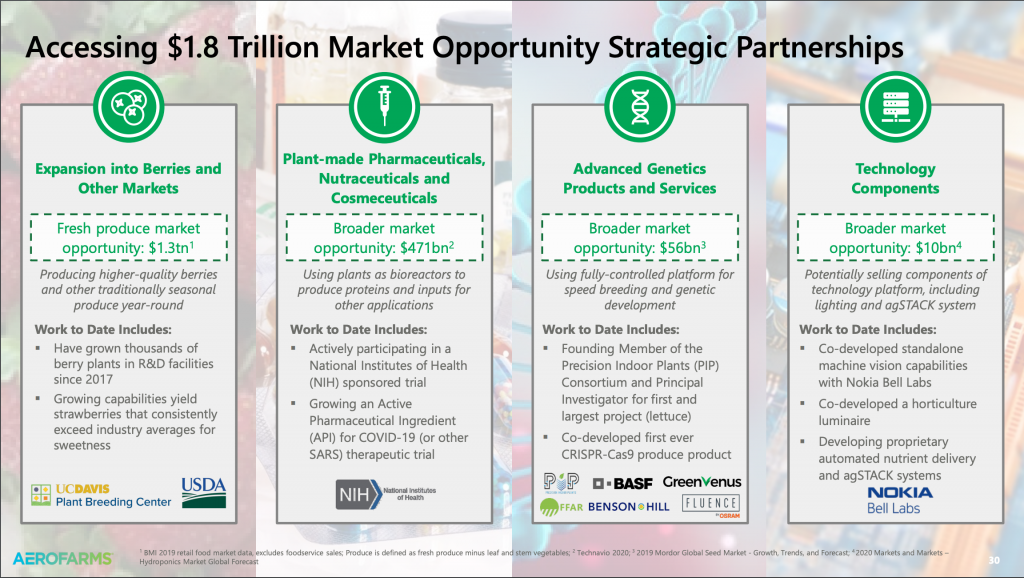
• AeroFarms, who has the largest indoor vertical farming facility in the world, co-developed the first CRISPR-Cas9 gene-edited produce product, now hundreds are following, while National Geographic believes that gene editing is the next food revolution. AeroFarms also worked on an NIH sponsored trial to produce proteins for the Covid jabs.
• The University of California is developing a plant-based mRNA vaccine in the hopes that farms can grow edible vaccine heads of lettuce.
• Monsanto/Bayer is creating gene edited seeds for vertical farm companies, while Bill Gates, the Rockefeller and Ford Foundations, and the World Bank control 10% of the world’s germplasms and hold some of the world’s largest seed banks. Bayer and BASF, two of the world’s largest suppliers of seed, are both involved with the vertical farm industry.
• The USDA and FDA have already approved lab grown meat, genetically modified cattle, and are funding the globalists to research and develop cellular agriculture as well as indoor growers and genetics companies, while they slack on regulations for gene-edited produce.
• Well over a dozen major food processing and meat plants have coincidentally gone up in flames in the past several months.
• Union Pacific is mandating railroad shipping reductions by 20%, impacting CF Industries Holdings, the world’s largest fertilizer company. Vanguard, BlackRock, and State Street happen to be the top shareholders of Union Pacific, and BlackRock and Vanguard are in the top 3 shareholders of CF Industries Holdings.
• By mapping some of the biggest vertical farms (below in this report), it reveals the crops, grocery stores involved, locations, and billions pouring in by globalist investors and shareholders. It quickly becomes evident that this is the global plan to control all produce – ingredients that go into all food products.
How Did They Lock This in Under The Radar? Some Critical Points:
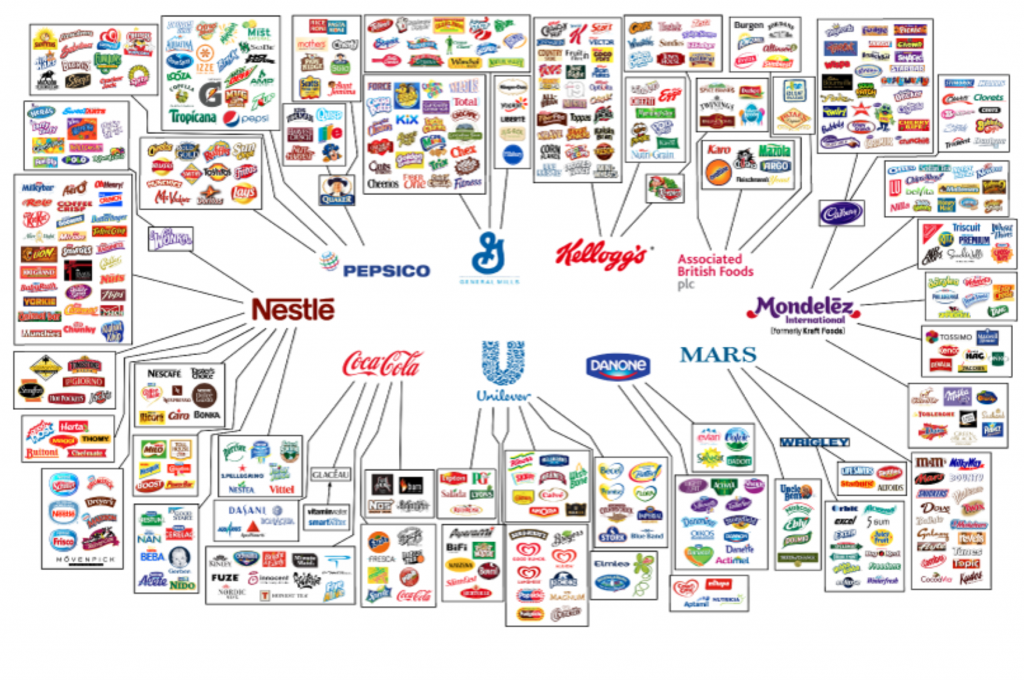
The food industry is already monopolized by 10 companies, the majority of which include Vanguard and BlackRock as top shareholders. What happens when they control all of the seeds, produce, and meat too? What happens when produce and meat are all grown inside secured facilities after a gene splice or inside a petri dish, and farmland becomes dormant due to overreaching regulations, lack of supplies, and manufactured inflation?
In 2014, during the Obama administration, congress established the Foundation for Food and Agriculture Research Act (FFAR) through the Farm Bill, which ultimately created a non-profit organization outside of the government with a $200 million kickoff from taxpayer dollars and additional millions in support from Bill Gates as seen here, and here. USDA Secretary Vilsack announced its creation on July 23, 2014, stating that they were appointing a 15-member board of directors which unsurprisingly included deputy director Dr. Robert Horsch of the Bill & Melinda Gates Foundation and high-ranking employees from Cargill and the Aspen Institute, among others. This new foundation would “leverage public and private resources to increase the scientific and technological research, innovation, and partnerships critical to boosting America’s agricultural economy.”
On April 2, 2019, FFAR announced they were launching Precision Indoor Plants (PIP) Consortium, a public-private partnership consisting of indoor growers, breeders, and genetics companies including AeroFarms, BASF, Benson Hill Biosystems, Fluence Bioengineering, Green Venus, Japan Plant Factory, and Priva. Their focus is on five key crops: lettuce, tomatoes, strawberries, cilantro, and blueberries, with a goal to advance speed-breeding, and to alter chemicals produced in plants that impact flavor, nutrition and medicines.
As quickly as Bill Gates was buying up farmland, money began pouring into the new future of food – urban vertical indoor farming where they claim the masses will all eventually migrate to. According to Research And Markets, the global vertical farming market was valued at $5.5 billion in 2020 and is projected to reach $19.86 billion in 2026. These growing facilities are astronomical in size as far as their ability to serve millions of people. For example, Bowery Farming is in the process of building their newest “smart” facility in Arlington, just outside of Dallas, TX, which will be capable of serving 16 million people within a 200-mile radius.
Bill Gates insists that droughts and climate change is destroying our ability to farm and that the future will consist of populations moving into metropolitan cities where indoor vertical farming is necessary to feed people. If this is the case, why has he acquired 242,000 acres of farmland over the past decade while simultaneously investing in indoor vertical farming? Who gets to sit at the table with healthy produce served up by Gates while the rest of the population eats gene-edited produce from locked-down facilities, delivered to their local grocery store, and accessed only through a digital ID?
Meanwhile, the Consultative Group of International Agriculture Research (CGIAR) holds the world’s largest private seed banks consisting of 10% of the worldwide germplasm across the globe, which is controlled by the Bill & Melinda Gates Foundation, Rockefeller and Ford Foundations, and World Bank, managing 768,576 accessions of hijacked farmers seeds.
Once the future of food through vertical farming took root, by August 2020, Monsanto/Bayer and Singapore’s sovereign fund Temasek launched a $30 million startup called Unfold which develops new vegetable seed varieties tailored to vertical farms. Bayer licensed the rights to seed germplasm from their vegetable portfolio. By 2021, they leased a 12,000 square foot laboratory research building in Davis, California. But don’t worry, rather than genetically modifying and inserting a gene into the DNA strand, like how Monsanto operated (acquired by Bayer in 2018), they only intend to cut a gene, still modifying its DNA. Perhaps this can be done in an effective and beneficial way, but at the hands of those behind all 2030 UN agendas, it gives one great pause. GMOs already account for 75-80% of food Americans consume.
There are already over 100 companies in the Sacramento area working on seed development, so it should come as no surprise that the University of California is developing a plant-based mRNA vaccine in the hopes that farms can grow edible vaccine lettuce. Sounds deliciously perfect. As with so many exciting projects such as this, the National Science Foundation granted $500,000 for this gem.
“Imagine walking into your local grocery store on a frigid January day to pick up freshly harvested lettuce, fragrant basil, juicy sweet strawberries, and ripe red tomatoes – all of which were harvested at a local farm only hours before you’d arrived.” That quote from the USDA’s article on Vertical Farming for the Future, published in October 2021, sounds so deliciously enticing and convenient, especially in anticipation of meeting the needs of 9 billion people by 2050, doesn’t it?
But, yes there’s always a “but,” what’s going to happen to the farmers when these astronomically enormous indoor vertical farm facilities have taken over every major city, locked in contracts with all major grocery store chains, and are funded by some of the same billionaire globalists who are seeking to control human beings through every industry for their fourth industrial revolution? It’s a legitimate concern. Add “gene-editing,” “smart,” “traceable,” and “net zero” to the production of these facilities, and the fact that they are still moving full speed ahead on digital IDs and currency, and it becomes even more concerning.
Sure, the idea of indoor vertical farming could be a great avenue for those with little land, those who live in harsher climates, and everyone who wants food security while these agendas against humanity continue to roll out, but wouldn’t it make more sense for communities to be doing this to meet their own needs, rather than relying on a digital ID to get access to a controlled food industry? The nutritional value from LED versus the sun likely removes some of the nutrients in the produce, but if faced with having difficulty accessing food, or not desiring gene-edited food, it might be a good idea.
Whereas this provides a lot of explanation on the absolute intentional demolition to all of our farmers on the seed, vegetable, and produce front, people should also be aware of what’s been taking place with cattle ranchers and the globalists’ plan to take over the meat industry as well. Lab grown meat has already been approved by the FDA and USDA to move forward in the U.S. and labs are eagerly filling up their petri dishes to get this ball rolling. In fact, back in September 2021, the USDA was seeking comments on the labeling of meat and poultry products derived from animals cells – in a press release that no one ever knew about. Upside Foods lab grown meat facility just launched in California, funded by Bill Gates, Temasek Holdings, and 37 other investors. Meanwhile, the USDA is still pushing for RFID surveillance of cattle and doing everything they can to control ranchers.
The USDA and FDA are fully on board with genetic modifications. First it was pigs, then it was salmon, now it’s cattle. Who knows what concoction will move from the petri dish to your dinner plate when it’s the same individuals behind every agenda.
On February 1, 2016 the Good Food Institute was launched by Bruce Friedrich with funding from the Bill & Melinda Gates Foundation, the Open Philanthropy Project, and Y Combinator, with the goal to “reimagine meat production.” In October 2021, the Good Food Institute celebrated the USDA’s $10 million grant for the creation of the first-ever National Institute for Cellular Agriculture at Tufts University so they can back researchers in manufactured meat.
To be certain all of these goals are locked into place and the UN 2030 agenda is achieved, disrupting the fertilizer industry, food supply chain, and a rash of coincidental fires to food processing plants sure would help to seal the deal, wouldn’t it?
Since the start of 2022, over a dozen major food processing and fertilizer plants have gone up in flames, exploded, or been struck by a plane crash in Arizona, Arkansas, California, Illinois, Indiana, Kansas, Louisiana, Maine, New Hampshire, North Carolina, Oregon, Texas, Washington, and Wisconsin. Nothing odd about this at all. Some articles on these fires can be found here, here, and here.
Some of the food processing plants that went up in flames: Azure Standard Foods Bonanza Meat Co. Cargill-Nutrena Feed Mill Deli Star East Conway Beef and Pork General Mills Idaho’s Gem State Processing Facility JBS Louis Dreyfus Company, largest soybean processing and biodiesel plant in the country Maid-Rite Steak Co. Maricopa Food Pantry McCrum Potato Facility Nestle Nutrien Ag Solutions Fertilizer Plant Raw Farm, largest raw milk producer in the country Rio Fresh Shearer’s Foods Smithfield Foods Taylor Farms Tyson Wisconsin River Meats
In February, the Weaver Fertilizer Plant in Winston-Salem caught fire, burning several hundreds tons of ammonium nitrate during a time when farmers were already concerned about getting enough fertilizer due to supply chain disruptions and inflation. So in an effort to make matters worse, without any advance notice, on April 8, 2022, Union Pacific began mandating railroad shipping reductions by 20%, impacting CF Industries Holdings, the world’s largest fertilizer company. Vanguard, BlackRock, and State Street happen to be the top shareholders of Union Pacific, and BlackRock and Vanguard are in the top 3 shareholders of CF Industries Holdings, along with T. Rowe Price Associates. This will directly impact key agricultural areas such as Iowa, Illinois, Kansas, Nebraska, Texas, and California. This will ultimately effect food supply and pricing. CF Industries is only one of 30 companies dealing with these restrictions.
The Canadian National Railway (CN), which runs from New Orleans up through Illinois, branching out through Michigan and Minnesota, up into Canada, alleges to be helping the fertilizer market grow. Are any of these affected companies utilizing CN? Coincidentally, Bill Gates holds the largest ownership stake in CN.
Surely, Bill Gates and friends will save the day through their Breakthrough Energy Ventures, whereby they have heavily invested in alternative fertilizers. The Breakthrough Energy Coalition launched in 2015 and originally listed the full group of 28 involved, which has since been scraped down to Bill Gates and the occasional mention of Jeff Bezos. It’s important to understand just how large this group is and how involved they’ve become in the energy sector. Corey’s Digs covered this group in a 2019 report involving dozens of islands they were infiltrating to run alternative energy and takeover their tourism. The University of California is part of this group, as well as Jeff Bezos, George Soros, Richard Branson, Jack Ma, Mark Zuckerberg, Marc Benioff, Reid Hoffman, Tom Steyer, Meg Whitman, and Nat Simons.
Bill Gates explained his love for fertilizer in 2018 while in Tanzania. Coincidentally, Gates-led and Rockefeller-funded Alliance for a Green Revolution in Africa (AGRA) has been an epic fail, with a first ever evaluation report coming out on February 28, 2022 after a 15-year effort with bold claims to rescue Africa’s small farmers. Their false promise to “double yields and incomes for 30 million farming households by 2020” was removed from their website in June 2020 after an assessment by Tufts University revealed little evidence of progress, and in fact showed a 31% increase in hunger. Evaluators stated there were many deficiencies and AGRA’s reporting and monitoring data was weak. Even the German government is considering pulling funding from AGRA over their pesticide use, which is ironic because Gates claims we need to remove pesticides in the U.S. and move to indoor vertical farming. Yes, USAID will of course continue their support to AGRA, having already contributed $90 million taxpayer dollars thus far. Full summary here.
One of AGRA’s biggest achievements was their participation in 72 agricultural policy reforms in 11 African countries, pertaining to seed, fertilizer and market access. Laws were created to protect intellectual property rights for “certified” seeds, as penalties were created for open-source seed sharing. Imagine being a farmer, homesteader or gardener and having to share and trade seeds on the black market so you don’t get penalized. Anyone who believes they won’t try this in the U.S. is kidding themselves, especially since the globalists hold the largest private seeds banks, and invest in the largest commercial seed companies. BASF, Corteva (formerly Dupont), Syngenta (part of ChemChina), and Monsanto (now Bayer) control roughly 50% of the global seed market.
On March 17, 2022 a notice was published to the U.S. Federal Register seeking comments by May 16, 2022 on Competition and Intellectual Property System: Seeds and Other Agricultural Inputs. Remember to read through the proper lens when reviewing this document notice that derived from an executive order signed by Biden in July, 2021 on promoting competition in the American economy.
Their ultimate goal – every human being, every piece of food, resource, and product on this planet will be tracked and traced via blockchain. This isn’t a theory – it is their goal. In July, 2021, the FDA released their “New Era of Smarter Food Safety” which consists of using tech-enabled traceability for a digital, traceable food system, from farm to plate using blockchain. A digital identity to grant access to establishments, control financial spending, and trace everyone’s moves has been rolling out on multiple fronts, including the vaccine ID passport. Eventually they will try to move toward a chip, as it will be easier with biometrics being installed everywhere.
Urban, Globalist-Controlled Indoor Vertical Farming is The Future of Food
2018 video on Feeding the World: From Mendel to CRISPR, presented by Carolyn Rasmussen
For clarification, gene editing varies from genetic modification. Whereas editing removes a splice, modification inserts a splice, but ultimately, both alter the overall DNA and both have been a hot controversial topic among scientists and individuals. Kicking off the presentation, Rasmussen makes a good argument, stating that humans have been cross breeding dogs for decades and have been selecting traits in crops, have grafted them, and cross-bred them for hundreds of years, leaving everyone to feel like a simple slice removed from the genetics of a carrot or wheat is no different, and in fact is needed to make them more drought tolerant or disease resistant, while also helping them to grow faster, making them more flavorful, and allegedly nutritious.
Whereas most people might say that it’s not right to alter nature, but when faced with starvation they may change their tune. So the real question one needs to ask is, are we faced with starvation, lack of land, drought, unusable soil and farmland, and all of the other scary stories that the globalists keep insisting people should fear right now? If that were the case, would Bill Gates have purchased 242,000 acres of farmland in the worst investment of the century? Unlikely.Is it a faster, less labor-intensive, pesticide-free, more convenient, environmentally friendly and a sustainable way to grow produce – through indoor vertical farming? That one is tough to argue. It’s actually quite brilliant, if not for the investors behind it and unregulated gene-editing taking place. Creating ones own vertical farm on their property might be the best option in this case.
The World Economic Forum assures us that urban indoor farming is the way of the future for our food, both in countless articles as well as videos featuring AppHarvest and AeroFarms.
Mapping Some of The Biggest Vertical Farms: Crops, Investors, Grocers & Locations
Why The Future of Farming is in Cities – video by Venture City
When people are rushing through the grocery store to pick up food for their families, and make a b-line for the produce section to grab bags of lettuce, fresh veggies, and fruit, most people don’t pay any attention to the brand itself, they just look at the expiration date and product. Meanwhile, a good chunk of grocery chains across the country are already serving up vertically grown food without people realizing what they’re buying. Are the products tasty, healthy, nutritious enough? Have they begun rolling out vaccines into lettuce at grocery stores? How would anyone know? What products have been gene-edited? This isn’t to fear monger, it’s to point out the rapidly changing industry which people know little about, so that people can start asking questions, do a little research, and perhaps begin growing their own food.
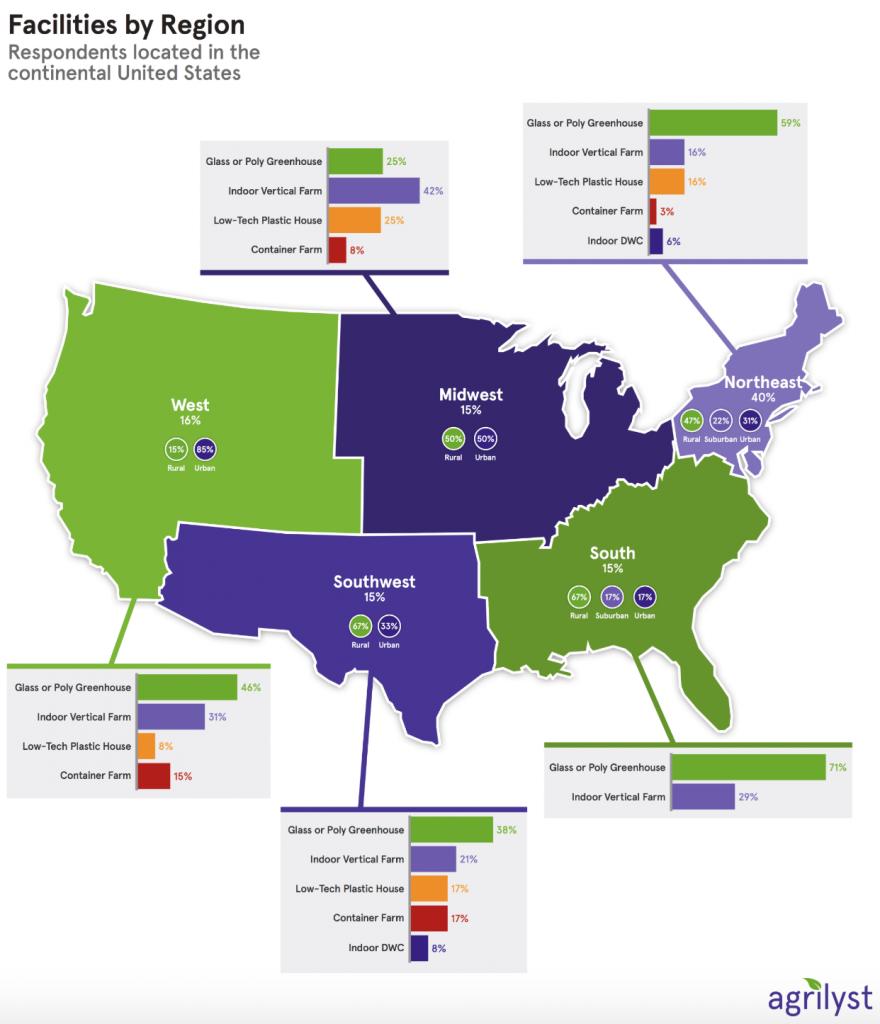
Vertical farming substitutes soil with aeroponics, hydroponics, or aquaponics. They all claim they can produce between 300-400 times more product than traditional farming. In a 2018 report by Agrilyst on indoor farming, they reported that glass or poly greenhouses were the most dominant at 47% followed by vertical farming at 30%. Those numbers have likely flipped by now.
AeroFarms (Dream Holdings, Inc.) Boasts the World’s Largest Indoor Farm
Founded in 2004 by David Rosenberg, Ed Harwood, and Marc Oshima, AeroFarms is a private company based in Newark, New Jersey and has thrived for much longer than the other vertical farms in this report. Having grown over 550 different crops, some of their main products include baby kale, watercress, and rocket, which are sold under the name Dream Greens, and they are now growing berries as well.
In 2017, AeroFarms received a $2 million grant from the Foundation for Food and Agriculture Research (FFAR), a nonprofit organization created in 2014 via the Farm Bill, to improve the characteristics of plants grown indoors to feed urban populations.
As of 2021, AeroFarms already had nine farms and was working on building a tenth. They state that they can go from seed to harvest in 15 days with their patented technology.
In 2021, Cargill announced its partnership with Aerofarms in a multi-year research collaboration on extending cocoa bean yields by experimenting with indoor growing technologies.
In February, 2021, the CEO of AeroFarms released a short video describing how they utilized one of their ten farms to scale up proteins for the Covid jab and boosters. They also indicated in a presentation that they had participated in growing an Active Pharmaceutical Ingredient for Covid-19 therapeutic trial sponsored by the NIH. The study on proteins from plant growth at AeroFarms and Fraunhofer, can be read here.
In a March 2021 SEC document pertaining to a potential merger between AeroFarms and Spring Valley Acquisition Corp, which later fell through, the CFO of AeroFarms highlighted their experience with advanced genetics, noting that:
“To be clear, we are a technology platform, not a conventional greenhouse grower using off-the-shelf equipment. We have had over 250 invention disclosures to date, a number which is constantly growing. We have grown over 550 different varieties of plants to date. We also see an addressable market in advanced genetics, using our platform for speed breeding and other genetic development work in plants. Here, we are a Founding Member of the Precision Indoor Plants Consortium and Principal Investigator for its first and largest project in lettuce. With this partnership, we work alongside companies like BASF to utilize our platform to optimize new genetics. Another example has to do with CRISPR-Cas9. If you’re not familiar, the Nobel Prize in Chemistry in 2020 went to the developers of CRISPR-Cas9, which is a genetic editing tool where scientists are able to pull out a genetic trait in a genetic sequence. Using our platform, we co-developed the first CRISPR-Cas9 produce product.”
In February 2022, AeroFarms partnered with Silal, Abu Dhabi’s leading fresh produce and agri-tech company, for a longterm research and development of transferring technology and data analytics of high tech farming systems. The goal is to improve the genetics and seedling quality of vegetables and fruit. They may also work with international consortia on developing new genotypes of crops.
AeroFarms serves grocery stores, distributors, and online grocers, some of which include: Amazon Fresh Baldor Specialty Foods FreshDirect Express online grocerShopRite Singapore Airlines Stop and Shop Walmart Whole Foods
They have both commercial and research and development farms in: Ithaca, New York Newark, New Jersey Danville, Virginia Abu Dhabi
Community Farms AeroFarms also partners with schools to teach students how to harvest their own greens. They’ve partnered with the World Economic Forum to bring community farms to Jersey City through a vertical farming initiative.
They’ve raised $238 million in funds from 13 investors: 21Ventures Abu Dhabi Investment Office AllianceBernstein Cibus Fund David Chang Foundation for Food and Agriculture Research GSR Ventures Ingka Group (parent company of IKEA) Meraas Middleland Capital MissionPoint Capital Partners Newark Venture Partners Wheatsheaf Group Ltd
According to Venture City, Ingka Group kicked them off with $500 million.
80 Acres Farms
80 Acres Farms was founded in 2015 by Mike Zelkind and Tisha Livingston and is a private company headquartered in Hamilton, OH. They provide fruits and vegetables to over 600 retail and food service locations. Their robot-powered indoor farms are said to produce 300 times more food than a conventional farm, while using 100% renewable energy and consuming 97% less water. Their farms are powered by Infinite Farms, a company out of the Netherlands that provides complete design/build services for turn-key automated indoor farms. Aside from 80 Acres Farms, Infinite Acres partners are Netherlands-based Priva Holding BV, and UK-based Ocado.
80 Acres serves over 600 retailers, grocers and national distributors, including: Dorothy Lane Markets Jungle Jim’s Markets Kroger Kroger – Ocado Solutions ecommerce channel Restaurants Sysco The Fresh Market US Foods Whole Foods
Krogerhas been selling their greens and vegetables at 32 of their stores, and in 2021 expanded to 316 additional stores after a 15-month pilot program. These stores are all located in:
Alabama Arkansas Indiana Kentucky North Carolina Ohio
They’ve raised $250 million in funds from 10 investors: Barclays Beyond Net Zero Blue Earth Capital (backed by Partners Group and Wietlisbach Foundation) General Atlantic Orange Wings Capital PG Impact Investments QuietStar Capital Siemens Financial Services Taurus Virgo Investment Group