Why is the long desire to "own the weather" never a topic discussed in the context of "climate change?"
The image thumbnail used for this video was a recent image taken from Egypt who have taken a hit due to the recent weather catastrophe in Turkey. There were lots of discussions after the events in Turkey as to the nature of the weather events and whether there was any manipulation going on. I think we’re at a stage where these questions shouldn’t be left to the fringes of the “conspiracy” world, and this video is an attempt to aid that process and to demystify a lot of the conspiracy elements of this topic. As you will see, and as many of you already know, the desire to “own the weather” has been going on for a long time, and we can point to patents and efforts going back to the early 1900’s for techniques to manipulate the weather (see sources).
It’s ironic that at a time where virtue signaling is rife about the need to “combat climate change” that the mainstream entirely ignores and objects to any discussion about techniques that have been in place for many decades to manipulate and direct weather patterns, with an acknowledgement that those techniques can in turn have negative consequences. So we have to ask the question - That, if we are seeing any form of significant “climate change”, what has a bigger impact - Jonny up the road running his tractor to help feed a local community, or Mr. Stein over there in Silicon Valley remotely operating an ionospheric heating device?
The bigger point being, if the powers that be already “own the weather”, or are close to it, then presumably they have more than enough of an ability to artificially create the “climate change” that they so seek to use as the excuse to get us into our 15 minute 5G smart city apartments.
I believe therein lies the answer as to why it’s not a topic that can be acknowledged or discussed in the context of “climate change”. I also believe that in order to “build back better” a lot has to be destroyed first, and given that “climate change” is the premise which is required to cement in order to justify the pre-planned solutions it seems obvious to me that, unfortunately, we may continue to see an increase in severe weather events.
Primary inspiration for the video was Matt Landman's "Frankenskies" documentary. The intro sequence and David Keith footage is lifted from his documentary. You can watch and support his work via: https://frankenskies.com
Update (1300ET): During a press conference, the NTSB referenced a video from Salem, Ohio, about 20 miles from East Palestine which shows sparks and flames emitting from beneath the train. The apparent structural issue with the train was captured on a security camera when it was travelling through Salem. According to Michael Graham, board member on the NTSB, two videos they had obtained were indicative of mechanical issues attributed to the rail car axles which likely led to the derailment.
The second video obtained from when the train was passing through Salem was recorded by a processing plant nearby a hotbox detector which scans the temperature of the axles as trains pass by. According to Graham, the wayside defect detector reading resulted in an alarm alerting the crew of a mechanical issue shortly before the derailment in East Palestine. Consequently, that alert forced the train to execute an emergency brake application which may have been the cause of the derailment. Presently, the NTSB is reviewing the trains data and audio recordings in order to examine the cause of the derailment and which hotbox detector indicated a mechanical error preceding the accident. The NTSB is expected to issue a preliminary report on its findings within 30 days.
* * *
Submitted by 'BlueApples',
While the US government is dispensing millions of dollars in resources to treat balloons as an existential crisis, a small town in Ohio finds itself engulfed in what actually looks like the apocalypse. Perhaps by design, all of the drama surrounding violations of US airspace by Chinese spy initiatives has done well to keep what is becoming one of the worst environmental disasters in recent memory from getting any headlines.
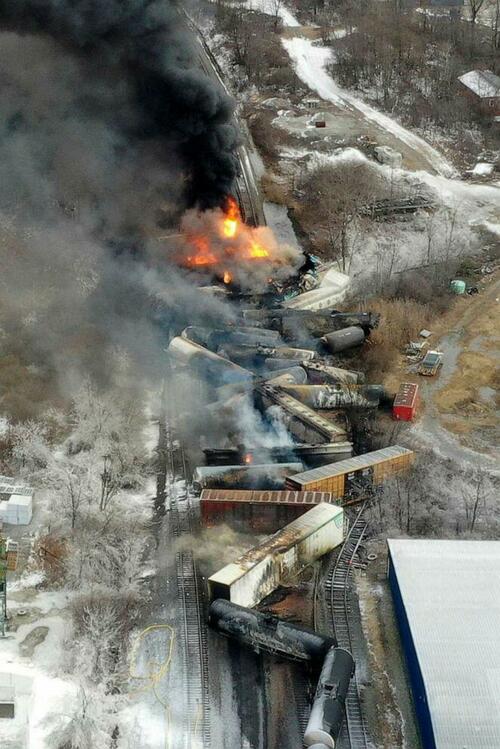
The chaos began early last week when a train of more than 100 cars derailed in East Palestine, Ohio near the state’s border with Pennsylvania with roughly 5,000 residents. The accident launched fifty of those hundred freight cars from the tracks. Twenty of the freight cars on the train were carrying hazardous materials, ten of which were derailed. While the accident had no fatalities, of those ten cars, five contained pressurized vinyl chloride, a highly flammable carcinogenic gas.
Scenes from East Palestine
In order to address the volatile scenario around the crash site, the Ohio Emergency Management Agency executed its plan of venting the toxic gas with a controlled burn in order to evade an uncontrolled explosion which presented the risk of catastrophic damage. “Within the last two hours, a drastic temperature change has taken place in a rail car, and there is now the potential of a catastrophic tanker failure which could cause an explosion with the potential of deadly shrapnel traveling up to a mile,” Gov. Mike DeWine warned in statement explaining the decision to take action to avert widespread devastation.
However, that operation sent large plumes of smoke containing vinyl chloride, phosgene, hydrogen chloride, and other gases into the air as the flames from the controlled burn raged on for days. Phosgene in particular is a highly toxic gas that can cause vomiting and respiratory issues. The toxicity of phosgene gas is so potent that it was previously used as a chemical weapon during the First World War.
NEW TOXINS IDENTIFIED—“We basically nuked a town with chemicals so we could get a railroad open,” said Sil Caggiano, a hazardous materials specialist. Rail company Norfolk Southern is paying just $25k to the town, or ~$5 per resident.🧵
The hazardous airborne chemicals prompted officials to issue mandatory evacuation and shelter-in-place orders within a one-mile radius of where the train derailed. Those orders forced nearly 2,000 residents of East Palestine out of their homes. Despite the public safety risk in proximity to the crash site, over 500 people within the parameters of the evacuation order refused to leave their homes. However, those orders were lifted on February 8th, allowing residents to return to the area adjacent to the disaster.
Following the controlled burn, local authorities received multiple concerning reports from residents outside of the mile-long radius of the evacuation area conveying that the emergency posed by the disaster was far from over. One local farmer reported the sudden deaths of many of the animals on the premises of his farm, Park Dairy. The farmer, Taylor Holzer, also works with the Ohio Department of Natural Resources as a registered foxkeeper. Following the disbursement of chemical agents into the air from the controlled burn, many of the foxes on Holzer’s farm experienced fatal effects from the air quality surrounding the area.
“Out of nowhere, he [a fox] just started coughing really hard, just shut down,” Holzer recalled to local media outlet WKBN 27 News. “This is not how a fox should act. He is very weak, limp. His eyes are very watery and weepy. Smoke and chemicals from the train, that’s the only thing that can cause it, because it doesn’t just happen out of nowhere,” he added.
“The chemicals that we’re being told are safe in the air, that’s definitely not safe for the animals…or people.”
Dead fish are being pulled from rivers outside East Palestine, Ohio.
The trucks doing the work are labeled EnviroScience, an Ohio-based company that provides "time-sensitive solutions to environmental challenges."
#6 The EPA sent a letter to the rail company, stating that ethylene glycol monobutyl ether, ethlyhexyl acrylate, & isobutylene were also in the rail cars.
“We basically nuked a town with chemicals so we could get a railroad open.”https://t.co/C69iWUpMvK
Holzer’s concerns were echoed by reports from other residents who described similar conditions near their own properties. One of those residents was Katlyn Schwarzwaelder, the operator of a local dog kennel in nearby Darlington, Pennsylvania. The catastrophe caused her to leave her home despite the fact that it lies more than 10 miles away from the site of the controlled burn. After fleeing to Boardman, Ohio, 15 miles away from the derailment, Schwarzwaelder stated she received multiple reports of dead chickens, fish, and other animals from friends and acquaintances. One affected resident told Schwarzwaelder that they let their 2-year old dog out to use the bathroom only for it never to return. When they embarked upon a search for their missing pet, they found it dead in their yard.
Testimony from Holzer, Schwarzwaelder, and others paints a drastically different picture than the official narrative tailored by officials who assured residents that the situation was under control. The poor air quality presents short and long term health risks to the public considering the carcinogenic effects of the chemicals. Carcinogens like vinyl chloride can cause cancer in organs including the liver, according to Kevin Crist, a professor of chemical and biomolecular engineering who also serves as the Director of Ohio University’s Air Quality Center.
Although officials in charge of the emergency response utilized techniques like dispersion modeling in order to calculate and mitigate the risk of airborne chemicals, the chemicals disbursed following the derailment pose other significant risks of contamination. Chemicals also spilled into the Ohio River toward West Virginia, prompting officials from the neighboring state to shut down water production in the area and turn to alternative sources for water supply. Soil contamination is another significant risk that leaves officials weary of broader implications affecting public health than those associated with the air pollution alone.
However, the magnitude of those risks hasn’t been apparently recognized by the leadership across various states affected by the disaster. According to Pennsylvania Governor Josh Shapiro, there were no concerns regarding the air and water quality in the area. Nevertheless, the governor reiterated that a shelter-in-place order remained in effect for Pennsylvanians within two miles of East Palestine. Officials from the Environmental Protection Agency took a similar tone, stating nothing unexpected was seen following the controlled burn. James Justice of the EPA summed up his agencies position by saying “So far, so good and we’re going to continue to monitor until the fire’s out,”.
While the immediate risks presented by a possible explosion following the train’s derailment may have been averted, the emergency response may become an instance of a cure being worse than the disease it seeks to remedy. The accidents also brings the state of safety regulations surrounding rail transport of hazardous freight into a new light. Over the last five years alone, eight train derailments have occurred in the Pittsburgh metro area, leading to calls for increased oversight over the industry.
Despite the inherent risk that comes with transporting chemicals like vinyl chloride, the US Department of Transportation approved a rule to expand the scope of what hazardous materials can be transported by rail. The rule made it permissible for liquefied natural gas to be shipped by train without additional safety regulations. This enables freight trains to transport 100 more tank cards with up to 30,000 gallons of the natural gas extracted from shale fields.
“The risks of catastrophic liquefied natural gas releases in accidents is too great not to have operational controls in place before large blocks of tank cars and unit trains proliferate,” the National Transportation Safety Board wrote in a comment if support of the proposed rule. In response to that comment, critics of the rule highlighted how a potential explosion of just twenty-two tank cards filled with liquefied natural gas holds the same amount of explosive energy as the atomic bomb dropped on Hiroshima in the waning days of the Second World War.
This chemical release in Ohio looks really bad, and the media is barely talking about it.
The ongoing crisis in East Palestine represents an environmental and humanitarian disaster that hasn’t been seen in the United States in recent memory. The scenes from East Palestine look as if they’re taken straight out of a horror film depicting nuclear winter.
I’m trying to gather information on this very serious situation in Ohio involving a train derailment with hazardous chemicals.
What I will say is this. Trust your eyes, ears and nose and get the hell out of there if your senses are telling you too.
Yes, this video is an oldie, but a great reminder of the event that changed the world which if most could use critical thinking, they'd be on the same page as those who follow my blog.
“One of the saddest lessons of history is this: If we’ve been bamboozled long enough, we tend to reject any evidence of the bamboozle. We’re no longer interested in finding out the truth. The bamboozle has captured us. It’s simply too painful to acknowledge, even to ourselves, that we’ve been taken. Once you give a charlatan power over you, you almost never get it back.” ― Carl Sagan, The Demon-Haunted World: Science as a Candle in the Dark