
This information provided by Heresy Financial seems to be spot on in terms of the how the controllers of the world will implement their precious CBDC (central bank digital currency).
This information provided by Heresy Financial seems to be spot on in terms of the how the controllers of the world will implement their precious CBDC (central bank digital currency).

The Federal Reserve has announced a timeline for the launch of its long-awaited FedNow payment service that will let banks offer customers instantly available funds and execute real-time payments, with critics flagging concerns like lack of cross-border payment processing and raising questions about surveillance.
The Fed announced on Wednesday that it will begin formal certification of participants in the FedNow system in April in anticipation of a July launch.
First announced in 2019, FedNow will allow banks to instantly transfer payments across the financial system.
“With the launch drawing near, we urge financial institutions and their industry partners to move full steam ahead with preparations to join the FedNow Service,” Ken Montgomery, first vice president of the Federal Reserve Bank of Boston and FedNow program executive, said in a statement.
As banks and other financial institutions join the program, this will create a growing network with clearing and settlement features that lets businesses and individuals send and receive instant payments at any time of day.
Recipients using the system will have full access to funds immediately, making it easier to make time-sensitive payments.
Some analysts have said that FedNow could reduce demand for payday loans because customers who use the system would receive their pay immediately, without having to wait for checks to clear.
“The launch reflects an important milestone in the journey to help financial institutions serve customer needs for instant payments to better support nearly every aspect of our economy,” Tom Barkin, president of the Federal Reserve Bank of Richmond and the FedNow Program’s executive sponsor, said in a statement.
The system will have the capacity to support various types of transactions: consumer-to-consumer, consumer-to-merchant, merchant-to-merchant, and bank-to-bank.
Fed governor Michelle Bowman said last year that FedNow could offer some of the same benefits as a central bank digital currency (CBDC) and thus weakening the case for the adoption of a CBDC, which is, anyway, years away in the United States.
During congressional testimony in early March, Fed chair Jerome Powell was asked by a lawmaker whether there’s an advantage to the FedNow payment system over a CBDC or stablecoins that also tout faster payment services.
“A CBDC is going to be years in evaluation,” Powell replied.
“And I think we can get this into the hands of the public very quickly, and we’ll have real-time payments in this country very very soon.”
FedNow “will enable all the banks—any bank in the United States, not just the big ones—to offer instantly available funds and real-time payments to their customers,” Powell said before the House Financial Services Committee on March 8. “That’s a great thing.”
A similar private-sector payment system that offers instant settlement features like FedNow has been around since 2017.
The Fed’s announcement of a timeline for the launch was met with mixed reactions. Some sought to draw equivalence between FedNow and a CBDC.
“Right on schedule. Here is your CBDC launch,” Lawrence Lepard, investment manager at Equity Management Associates, stated in a tweet.
Scott Santens, author of the book “Let There Be Money,” disputed this characterization, arguing in a series of tweets that FedNow doesn’t have any smart contract ability and is not equivalent to a digital dollar.
“FedNow implementation is one of the arguments against launching a CBDC. It’s so not a CBDC that it actually reduces the odds of starting a CBDC,” he wrote on Twitter.
“If conspiracy theorists who are afraid of CBDC had any sense at all, they’d argue that FedNow obviates the need for a CBDC. They’d welcome FedNow as an alternative that already exists, so don’t do a CBDC. But they have no sense,” Santens added.
Jordan Schachtel, publisher of The Dossier on Substack, raised concerns about surveillance.
“FedNow appears to be a prototype CBDC,” he stated in a tweet. “While instant, 24/7 payments seems good, there’s implications to leaning into credit-based system. FedNow can quickly transform to a surveillance system.”
“Does FedNow have AI or human circuit breaker managing it? FedNow is a giant red flag,” he added.
According to a review of FedNow by PYMNTS, the new platform might, over time, incorporate anti-fraud features that “could provide the ability to fine-tune controls for different types of customers and screen non-value messages, such as requests to send payments to potential bad actors.”
“Other updates under consideration would leverage the FedNow Service network to monitor for aggregated concentrations of inbound and outbound activity (a sign of potential mule activity) and use machine learning to score transactions,” PYMNTS noted.
The Fed said in its announcement that the service will launch with a “robust set of core clearing and settlement functionality and value-added features” and that that enhancements would be added in future releases including ones related to “safety, resiliency and innovation.”
Matt Stoller, director of research at the American Economic Liberties Project, welcomed FedNow as a better alternative to currently used payment systems.
“The administration needs to push the Fed to get FedNow working ASAP. It’s just ridiculous the U.S. payments system is so corrupt and expensive, versus the fast and efficient systems of almost everywhere else,” he wrote in a tweet.
Payment systems used in the United States face criticism for lack of interoperability, high transactions fees, and slow processing times, which in some cases can take several days.
Rina Wulfing, policy and campaign manager for London-based cross-border payments company Wise, said that a shortcoming of the FedNow system is that it doesn’t include nonbanks and cross-border payments.
“Unfortunately, the current framework does not address the other most pressing issues in the U.S. payments system,” Wulfing wrote in a recent op-ed. “By not including nonbanks and cross-border payments, FedNow puts itself at risk for success and doesn’t take into account the needs of U.S. consumers. ”
Controversy has surrounded the adoption of CBDCs, with House Republicans warning of the risk that they could amount to an “authoritarian-style” and “surveillance-style” digital dollar.
House Republicans recently introduced the CBDC Anti-Surveillance State Act that would restrict the “unelected bureaucrats” from establishing and issuing a CBDC that they say would threaten the financial privacy of the American people.
“Any digital version of the dollar must uphold our American values of privacy, individual sovereignty, and free-market competitiveness,” said House Majority Whip Tom Emmer (R-Minn.) in a statement.
“Anything less opens the door to the development of a dangerous surveillance tool.”
Rep. Warren Davidson (R-Ohio) argued that the Fed must concentrate on its dual mandate—price stability and maximum employment—instead of “eradicating financial autonomy.”
“A retail CBDC would essentially allow the government to mediate all transactions, which would mirror what we see in China. It’s vital to ensure this does not happen here,” Davidson said in a statement.
SOURCE: Zero Hedge
Also...watch this video from YouTube Channel DAHBOO77 for more commentary.
 |
| Image Source: UNREVEALED FILES |
Via J Wilderness:
The image thumbnail used for this video was a recent image taken from Egypt who have taken a hit due to the recent weather catastrophe in Turkey. There were lots of discussions after the events in Turkey as to the nature of the weather events and whether there was any manipulation going on. I think we’re at a stage where these questions shouldn’t be left to the fringes of the “conspiracy” world, and this video is an attempt to aid that process and to demystify a lot of the conspiracy elements of this topic. As you will see, and as many of you already know, the desire to “own the weather” has been going on for a long time, and we can point to patents and efforts going back to the early 1900’s for techniques to manipulate the weather (see sources).
It’s ironic that at a time where virtue signaling is rife about the need to “combat climate change” that the mainstream entirely ignores and objects to any discussion about techniques that have been in place for many decades to manipulate and direct weather patterns, with an acknowledgement that those techniques can in turn have negative consequences. So we have to ask the question - That, if we are seeing any form of significant “climate change”, what has a bigger impact - Jonny up the road running his tractor to help feed a local community, or Mr. Stein over there in Silicon Valley remotely operating an ionospheric heating device?
The bigger point being, if the powers that be already “own the weather”, or are close to it, then presumably they have more than enough of an ability to artificially create the “climate change” that they so seek to use as the excuse to get us into our 15 minute 5G smart city apartments.
I believe therein lies the answer as to why it’s not a topic that can be acknowledged or discussed in the context of “climate change”. I also believe that in order to “build back better” a lot has to be destroyed first, and given that “climate change” is the premise which is required to cement in order to justify the pre-planned solutions it seems obvious to me that, unfortunately, we may continue to see an increase in severe weather events.
J Wilderness [https://www.linktr.ee/JWilderness] 🙏
Primary inspiration for the video was Matt Landman's "Frankenskies" documentary. The intro sequence and David Keith footage is lifted from his documentary. You can watch and support his work via: https://frankenskies.com

Update (1300ET): During a press conference, the NTSB referenced a video from Salem, Ohio, about 20 miles from East Palestine which shows sparks and flames emitting from beneath the train. The apparent structural issue with the train was captured on a security camera when it was travelling through Salem. According to Michael Graham, board member on the NTSB, two videos they had obtained were indicative of mechanical issues attributed to the rail car axles which likely led to the derailment.
The second video obtained from when the train was passing through Salem was recorded by a processing plant nearby a hotbox detector which scans the temperature of the axles as trains pass by. According to Graham, the wayside defect detector reading resulted in an alarm alerting the crew of a mechanical issue shortly before the derailment in East Palestine. Consequently, that alert forced the train to execute an emergency brake application which may have been the cause of the derailment. Presently, the NTSB is reviewing the trains data and audio recordings in order to examine the cause of the derailment and which hotbox detector indicated a mechanical error preceding the accident. The NTSB is expected to issue a preliminary report on its findings within 30 days.
* * *
Submitted by 'BlueApples',
While the US government is dispensing millions of dollars in resources to treat balloons as an existential crisis, a small town in Ohio finds itself engulfed in what actually looks like the apocalypse. Perhaps by design, all of the drama surrounding violations of US airspace by Chinese spy initiatives has done well to keep what is becoming one of the worst environmental disasters in recent memory from getting any headlines.
The chaos began early last week when a train of more than 100 cars derailed in East Palestine, Ohio near the state’s border with Pennsylvania with roughly 5,000 residents. The accident launched fifty of those hundred freight cars from the tracks. Twenty of the freight cars on the train were carrying hazardous materials, ten of which were derailed. While the accident had no fatalities, of those ten cars, five contained pressurized vinyl chloride, a highly flammable carcinogenic gas.
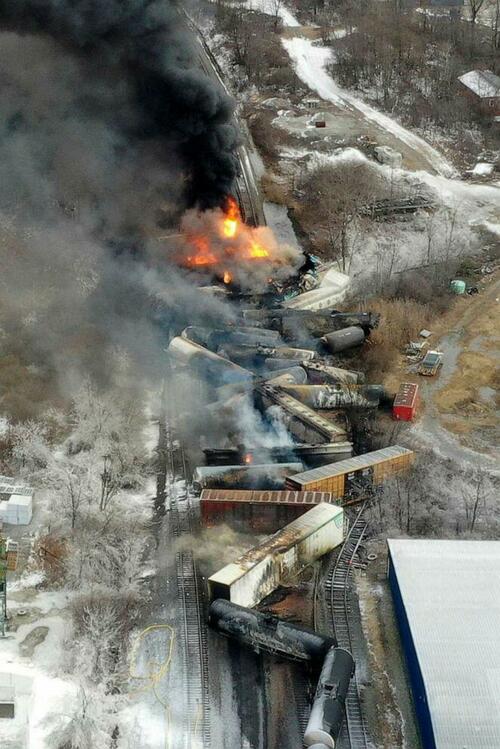
In order to address the volatile scenario around the crash site, the Ohio Emergency Management Agency executed its plan of venting the toxic gas with a controlled burn in order to evade an uncontrolled explosion which presented the risk of catastrophic damage. “Within the last two hours, a drastic temperature change has taken place in a rail car, and there is now the potential of a catastrophic tanker failure which could cause an explosion with the potential of deadly shrapnel traveling up to a mile,” Gov. Mike DeWine warned in statement explaining the decision to take action to avert widespread devastation.
However, that operation sent large plumes of smoke containing vinyl chloride, phosgene, hydrogen chloride, and other gases into the air as the flames from the controlled burn raged on for days. Phosgene in particular is a highly toxic gas that can cause vomiting and respiratory issues. The toxicity of phosgene gas is so potent that it was previously used as a chemical weapon during the First World War.
NEW TOXINS IDENTIFIED—“We basically nuked a town with chemicals so we could get a railroad open,” said Sil Caggiano, a hazardous materials specialist. Rail company Norfolk Southern is paying just $25k to the town, or ~$5 per resident.🧵
— Eric Feigl-Ding (@DrEricDing) February 13, 2023
HT @therecount
pic.twitter.com/7jVQaIFA1U
The hazardous airborne chemicals prompted officials to issue mandatory evacuation and shelter-in-place orders within a one-mile radius of where the train derailed. Those orders forced nearly 2,000 residents of East Palestine out of their homes. Despite the public safety risk in proximity to the crash site, over 500 people within the parameters of the evacuation order refused to leave their homes. However, those orders were lifted on February 8th, allowing residents to return to the area adjacent to the disaster.
Following the controlled burn, local authorities received multiple concerning reports from residents outside of the mile-long radius of the evacuation area conveying that the emergency posed by the disaster was far from over. One local farmer reported the sudden deaths of many of the animals on the premises of his farm, Park Dairy. The farmer, Taylor Holzer, also works with the Ohio Department of Natural Resources as a registered foxkeeper. Following the disbursement of chemical agents into the air from the controlled burn, many of the foxes on Holzer’s farm experienced fatal effects from the air quality surrounding the area.
“Out of nowhere, he [a fox] just started coughing really hard, just shut down,” Holzer recalled to local media outlet WKBN 27 News. “This is not how a fox should act. He is very weak, limp. His eyes are very watery and weepy. Smoke and chemicals from the train, that’s the only thing that can cause it, because it doesn’t just happen out of nowhere,” he added.
“The chemicals that we’re being told are safe in the air, that’s definitely not safe for the animals…or people.”
Dead fish are being pulled from rivers outside East Palestine, Ohio.
— 🇺🇸Texas Tweetheart🇺🇸 (@MechelleChristy) February 13, 2023
The trucks doing the work are labeled EnviroScience, an Ohio-based company that provides "time-sensitive solutions to environmental challenges."
Join @CBKNEWS pic.twitter.com/yoZhZwxgEJ
#8 There are reports of dead fish in rivers and creeks 5 miles away from the train derailment.https://t.co/5Jgs1L52W4 pic.twitter.com/G43pdY41RB
— kanekoa.substack.com (@KanekoaTheGreat) February 13, 2023
#9 Dead fish in Leslie Run coming out of East Palestine, Ohio. pic.twitter.com/E7LdETovqJ
— kanekoa.substack.com (@KanekoaTheGreat) February 13, 2023
#6 The EPA sent a letter to the rail company, stating that ethylene glycol monobutyl ether, ethlyhexyl acrylate, & isobutylene were also in the rail cars.
— kanekoa.substack.com (@KanekoaTheGreat) February 13, 2023
“We basically nuked a town with chemicals so we could get a railroad open.”https://t.co/C69iWUpMvK
#7 Amanda Breshears found her chickens dead ten miles from East Palestine.
— kanekoa.substack.com (@KanekoaTheGreat) February 13, 2023
“As soon as they started the burn, my chickens slowed down and they died."
“If it can do this to chickens in one night, imagine what it’s going to do to us in 20 years.”https://t.co/aPEzNkPupW pic.twitter.com/hy5umayYXU
Holzer’s concerns were echoed by reports from other residents who described similar conditions near their own properties. One of those residents was Katlyn Schwarzwaelder, the operator of a local dog kennel in nearby Darlington, Pennsylvania. The catastrophe caused her to leave her home despite the fact that it lies more than 10 miles away from the site of the controlled burn. After fleeing to Boardman, Ohio, 15 miles away from the derailment, Schwarzwaelder stated she received multiple reports of dead chickens, fish, and other animals from friends and acquaintances. One affected resident told Schwarzwaelder that they let their 2-year old dog out to use the bathroom only for it never to return. When they embarked upon a search for their missing pet, they found it dead in their yard.
Testimony from Holzer, Schwarzwaelder, and others paints a drastically different picture than the official narrative tailored by officials who assured residents that the situation was under control. The poor air quality presents short and long term health risks to the public considering the carcinogenic effects of the chemicals. Carcinogens like vinyl chloride can cause cancer in organs including the liver, according to Kevin Crist, a professor of chemical and biomolecular engineering who also serves as the Director of Ohio University’s Air Quality Center.
Although officials in charge of the emergency response utilized techniques like dispersion modeling in order to calculate and mitigate the risk of airborne chemicals, the chemicals disbursed following the derailment pose other significant risks of contamination. Chemicals also spilled into the Ohio River toward West Virginia, prompting officials from the neighboring state to shut down water production in the area and turn to alternative sources for water supply. Soil contamination is another significant risk that leaves officials weary of broader implications affecting public health than those associated with the air pollution alone.
However, the magnitude of those risks hasn’t been apparently recognized by the leadership across various states affected by the disaster. According to Pennsylvania Governor Josh Shapiro, there were no concerns regarding the air and water quality in the area. Nevertheless, the governor reiterated that a shelter-in-place order remained in effect for Pennsylvanians within two miles of East Palestine. Officials from the Environmental Protection Agency took a similar tone, stating nothing unexpected was seen following the controlled burn. James Justice of the EPA summed up his agencies position by saying “So far, so good and we’re going to continue to monitor until the fire’s out,”.
While the immediate risks presented by a possible explosion following the train’s derailment may have been averted, the emergency response may become an instance of a cure being worse than the disease it seeks to remedy. The accidents also brings the state of safety regulations surrounding rail transport of hazardous freight into a new light. Over the last five years alone, eight train derailments have occurred in the Pittsburgh metro area, leading to calls for increased oversight over the industry.
Despite the inherent risk that comes with transporting chemicals like vinyl chloride, the US Department of Transportation approved a rule to expand the scope of what hazardous materials can be transported by rail. The rule made it permissible for liquefied natural gas to be shipped by train without additional safety regulations. This enables freight trains to transport 100 more tank cards with up to 30,000 gallons of the natural gas extracted from shale fields.
“The risks of catastrophic liquefied natural gas releases in accidents is too great not to have operational controls in place before large blocks of tank cars and unit trains proliferate,” the National Transportation Safety Board wrote in a comment if support of the proposed rule. In response to that comment, critics of the rule highlighted how a potential explosion of just twenty-two tank cards filled with liquefied natural gas holds the same amount of explosive energy as the atomic bomb dropped on Hiroshima in the waning days of the Second World War.
This chemical release in Ohio looks really bad, and the media is barely talking about it.
— Hodgetwins (@hodgetwins) February 13, 2023
Where are all the climate activists at? pic.twitter.com/ZVI2xfBuKG
The ongoing crisis in East Palestine represents an environmental and humanitarian disaster that hasn’t been seen in the United States in recent memory. The scenes from East Palestine look as if they’re taken straight out of a horror film depicting nuclear winter.
I’m trying to gather information on this very serious situation in Ohio involving a train derailment with hazardous chemicals.
— Erin Brockovich (@ErinBrockovich) February 11, 2023
What I will say is this. Trust your eyes, ears and nose and get the hell out of there if your senses are telling you too.
Source: Zero Hedge

